
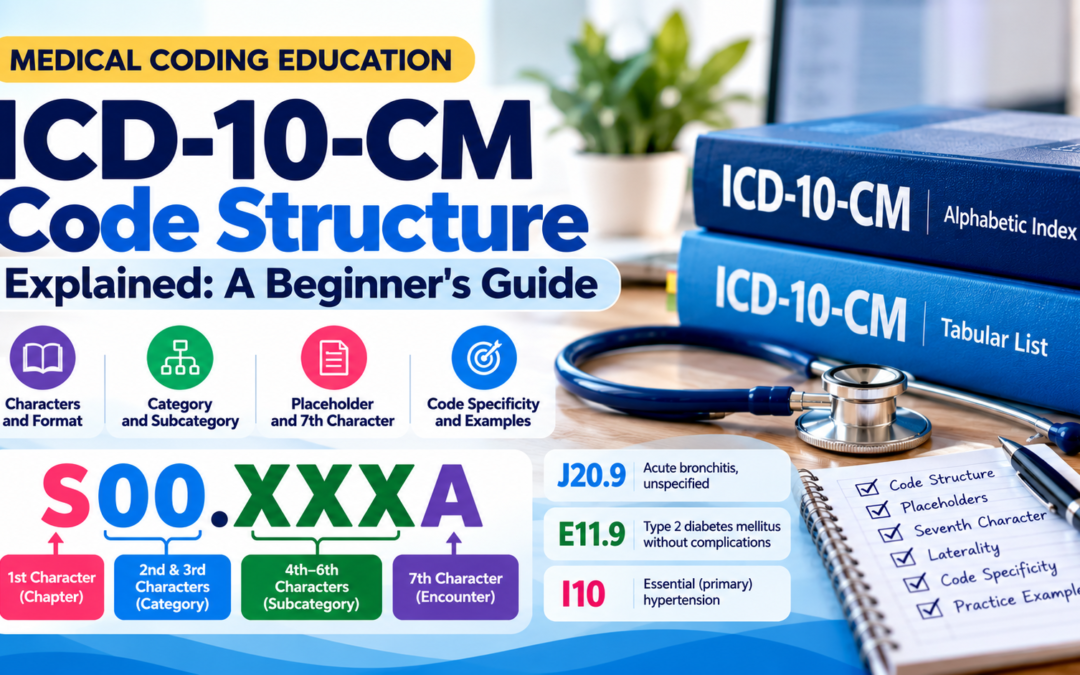
ICD-10-CM Code Structure Explained: A Beginner’s Guide
Introduction
Understanding the structure of ICD-10-CM diagnosis codes is an essential skill for medical coding students and professional medical coders. Before assigning diagnosis codes, coders must understand how codes are organized, how their characters are arranged, and how to identify requirements such as placeholders and seventh characters.
ICD-10-CM stands for the International Classification of Diseases, Tenth Revision, Clinical Modification. It is used to classify diagnoses and health conditions in healthcare settings in the United States.
Each ICD-10-CM code represents a particular diagnosis, condition, or clinical concept. Some codes are short and straightforward, while others require additional characters to provide more specific information.
In this beginner-friendly guide, we will explore the basic structure of ICD-10-CM codes, examine practical examples, and explain common mistakes to avoid when selecting diagnosis codes.
What You Will Learn
By the end of this article, you will be able to:
- Understand the basic structure of an ICD-10-CM code.
- Identify the different positions of characters within a code.
- Explain the purpose of placeholders.
- Understand when a seventh character may be required.
- Recognize the importance of code specificity.
- Apply a systematic process when reviewing diagnosis codes.
- Use official ICD-10-CM resources to verify codes.
1. What Is the Structure of an ICD-10-CM Code?
ICD-10-CM codes are alphanumeric. They contain letters and numbers arranged according to a defined classification structure.
An ICD-10-CM code generally contains three to seven characters. The first character is a letter, the second character is numeric, and the third character is also numeric. The characters after the third position may include letters or numbers, depending on the code.
A decimal point is placed after the third character.
Basic Code Structure
The general format is:
Category. Subcategory and additional characters
For example:
- J20.9 — Acute bronchitis, unspecified.
- E11.9 — Type 2 diabetes mellitus without complications.
- I10 — Essential (primary) hypertension.
These examples demonstrate that ICD-10-CM codes can vary in length. Not every code requires seven characters.
Important: These are educational examples. Verify each code’s current validity and complete description in the official code set applicable to the date of service.
2. Understanding the First Three Characters
The first three characters form the code category. They identify a broad group of related diseases, conditions, injuries, or other health-related circumstances.
Consider the example J20.9.
- J is the first character and identifies the broad chapter grouping.
- 2 is the second character.
- 0 is the third character.
- The first three characters, J20, identify the category.
- The decimal point separates the category from any characters that follow it.
- 9 is the fourth character in this example.
The category helps organize related conditions within the ICD-10-CM classification.
Why Are Categories Important?
Categories allow related diagnoses to be grouped together. However, identifying a category does not always provide enough detail for final code assignment.
Depending on the condition, additional characters may identify a specific type, location, severity, encounter, or other required detail.
Always review the full code structure in the Tabular List.
3. Understanding Characters After the Decimal Point
The characters following the decimal point provide additional specificity when required by the classification.
Depending on the code family, these characters may identify details such as:
- The specific condition or subtype.
- Anatomical location.
- Laterality, such as right or left.
- Encounter information for certain injuries.
- Other classification-specific details.
Not every code family uses the same character structure. The meaning of a character depends on the particular category and its instructions.
Example: A Code With One Character After the Decimal
J20.9 — Acute bronchitis, unspecified
This code has three characters before the decimal point and one character after it.
Example: A Code With Additional Characters
Some injury codes require several characters to represent the injury, anatomical site, laterality, and encounter information.
For these codes, selecting a category alone is insufficient. You must follow the instructions in the Tabular List to identify the complete and valid code.
4. What Is a Placeholder in ICD-10-CM?
A placeholder is a character used in certain ICD-10-CM codes to maintain the required position of subsequent characters.
The letter X is used as a placeholder where specified by the classification.
A placeholder may be necessary when a code requires a seventh character but does not contain enough characters before that position.
Why Is a Placeholder Necessary?
ICD-10-CM codes must follow the character structure specified for each code family. When a placeholder is required, omitting it can result in an invalid or incomplete code.
Example of Placeholder Use
Consider the general pattern:
S00.XXXA
This illustrates a code structure in which X characters occupy specified positions before the seventh character.
The example is intended to demonstrate the placement of placeholders. Before using any particular code, verify the complete code and its description in the official Tabular List.
Key Points About Placeholders
- The letter X is used as a placeholder when required.
- It is not optional when the classification specifies it.
- Its position matters.
- Placeholder requirements vary by code family.
- The official Tabular List should always be consulted.
5. What Is a Seventh Character in ICD-10-CM?
Some ICD-10-CM codes require a seventh character to provide additional information. This is especially common in certain injury codes, although seventh-character requirements also occur in other code families.
Depending on the applicable code category, a seventh character may identify information such as the encounter phase or another classification-specific detail.
Common Seventh-Character Concepts for Injuries
For many injury code families, the seventh-character options include:
A — Initial encounter
Used for qualifying encounters during active treatment of the injury. It does not simply mean the patient’s first visit to a particular healthcare provider.
D — Subsequent encounter
Used for qualifying encounters during routine healing or recovery after active treatment has been completed.
S — Sequela
Used for a residual effect or condition resulting from an earlier injury after the acute phase has ended.
The exact seventh-character options and their definitions depend on the code family. Always check the applicable Tabular List instructions and official guidelines.
Important Points About the Seventh Character
- Some codes require a seventh character, while others do not.
- The seventh character must occupy the correct position.
- A placeholder may be required to place the seventh character correctly.
- Encounter-character selection must follow the applicable coding guidelines.
- Do not select a seventh character based only on whether the visit is the patient’s first or later visit.
6. What Is Laterality in ICD-10-CM?
Laterality refers to the side of the body affected by a condition. Some ICD-10-CM code families distinguish between the right side, left side, and unspecified side.
When laterality is part of a code family, the code may require additional characters to indicate the affected side.
Why Is Laterality Important?
Consider a condition that affects a paired body part, such as the right or left ankle. If the applicable code family distinguishes between sides, the coder must use the side supported by the documentation.
Coding Tips for Laterality
- Review the provider’s documentation for the affected side.
- Locate the diagnosis in the Alphabetic Index.
- Verify the potential code in the Tabular List.
- Confirm the appropriate laterality character.
- Do not assume a side when the documentation does not support it.
If the documentation does not establish the required detail, follow the applicable coding guidelines and organizational procedures.
7. Understanding Code Specificity
Code specificity means selecting the most appropriate code supported by the medical documentation and required by the classification.
Some conditions have several related codes that distinguish between different types, locations, severities, or associated circumstances.
For example, the classification may distinguish between a condition with complications and the same condition without complications.
How to Select the Appropriate Level of Specificity
Follow these steps:
- Review the complete clinical documentation.
- Identify the diagnosis and its documented characteristics.
- Search the Alphabetic Index for the main term and relevant subterms.
- Verify the potential code in the Tabular List.
- Review inclusion terms, Excludes notes, and other applicable instructions.
- Confirm any required characters and code-specific details.
- Apply the relevant official coding guidelines.
Remember: More specific is not always better if the documentation does not support that specificity. The selected code must accurately reflect the documented condition and applicable coding rules.
8. How to Verify an ICD-10-CM Code
Understanding code structure is only one part of accurate diagnosis coding. Coders must also confirm that the code is valid and appropriate for the documented condition and date of service.
Step 1: Identify the Diagnosis
Read the medical record and identify the diagnosis documented by the healthcare provider.
Step 2: Search the Alphabetic Index
Locate the main term and review the applicable subterms. Follow cross-references and identify a potential code.
Step 3: Verify the Tabular List
Locate the potential code in the Tabular List and review its full description.
Step 4: Check the Character Requirements
Confirm whether the code requires additional characters, a placeholder, a seventh character, or laterality information.
Step 5: Review the Coding Instructions
Check all applicable notes and instructions, including sequencing requirements and any relevant chapter-specific guidelines.
Step 6: Confirm the Applicable Fiscal Year
ICD-10-CM codes and guidelines are updated periodically. Verify the code set that applies to the date of service.
Step 7: Finalize the Code When Supported
Ensure that the code is complete, valid, consistent with the documentation, and compliant with the applicable coding rules.
9. Common Mistakes When Reading ICD-10-CM Codes
Beginners may make mistakes when interpreting code characters or selecting a final code. The following practices can help prevent common errors.
Mistake 1: Using an Incomplete Code
Problem: Selecting a category without adding required characters.
Solution: Review the Tabular List and confirm whether additional characters are required.
Mistake 2: Ignoring Placeholder Requirements
Problem: Omitting an X when a placeholder is required.
Solution: Follow the exact character structure specified in the official code set.
Mistake 3: Forgetting the Seventh Character
Problem: Assigning a code without a required seventh character.
Solution: Check the code-specific instructions and identify the appropriate seventh character when applicable.
Mistake 4: Choosing the Wrong Encounter Character
Problem: Selecting an initial-encounter character simply because it is the patient’s first visit to a provider.
Solution: Apply the relevant definition for active treatment, subsequent care, or sequela according to the applicable code family and guidelines.
Mistake 5: Ignoring Laterality
Problem: Failing to distinguish between right, left, or unspecified sides when the code family requires it.
Solution: Review the documentation and confirm the appropriate code in the Tabular List.
Mistake 6: Relying Only on Memory
Problem: Assigning a code from memory without checking the official classification.
Solution: Use the Alphabetic Index, Tabular List, and applicable official guidelines to verify the code.
Mistake 7: Using an Outdated Reference
Problem: Applying a code or rule from an older fiscal year without checking for updates.
Solution: Consult the official code files and guidelines applicable to the date of service.
10. Practice Questions: ICD-10-CM Code Structure
Test your understanding with these beginner-friendly questions.
Question 1
What type of characters does an ICD-10-CM code contain?
A. Numbers only
B. Letters only
C. Letters and numbers
D. Symbols only
Correct answer: C. Letters and numbers
Explanation: ICD-10-CM uses alphanumeric codes containing letters and numbers arranged according to the classification structure.
Question 2
Where is the decimal point generally placed in an ICD-10-CM code?
A. After the first character
B. After the second character
C. After the third character
D. At the end of every code
Correct answer: C. After the third character
Explanation: The decimal point is placed after the third character in the standard ICD-10-CM code format.
Question 3
Which letter is used as a placeholder when required by the code structure?
A. A
B. X
C. Z
D. M
Correct answer: B. X
Explanation: The letter X is used as a placeholder in specified ICD-10-CM code structures.
Question 4
What should a medical coder do after locating a potential code in the Alphabetic Index?
A. Assign it immediately
B. Ignore the Tabular List
C. Verify the code in the Tabular List
D. Select any related code
Correct answer: C. Verify the code in the Tabular List
Explanation: The Alphabetic Index is a starting point. The Tabular List must be reviewed to verify the code and applicable instructions.
Question 5
What should a coder do when a code family requires a seventh character?
A. Leave the code incomplete
B. Add any character
C. Follow the code-specific instructions
D. Remove the decimal point
Correct answer: C. Follow the code-specific instructions
Explanation: The required seventh character and any placeholder must be selected according to the instructions for the particular code family.
11. Official ICD-10-CM Learning Resources
Medical coding students should use authoritative references when studying diagnosis codes.
CDC ICD-10-CM Browser Tool
The Centers for Disease Control and Prevention’s National Center for Health Statistics provides a browser tool for searching the Alphabetic Index and Tabular List.
Visit: https://icd10cmtool.cdc.gov/
CMS ICD-10 Code Files
The Centers for Medicare & Medicaid Services provides official ICD-10-CM code files, guidelines, and related updates.
Visit: https://www.cms.gov/medicare/coding-billing/icd-10-codes
ICD-10-CM Official Guidelines for Coding and Reporting
The official guidelines explain general coding principles, chapter-specific rules, and other requirements for accurate code assignment.
For encounters on or after October 1, 2026, consult the applicable FY 2027 code set and guidelines.
Guidelines resource: https://www.cms.gov/medicare/coding-billing/icd-10-codes
Study tip: Always confirm the applicable fiscal year and verify code descriptions, character requirements, and instructional notes using official resources.
Conclusion
Understanding ICD-10-CM code structure is a fundamental skill for medical coding students and CPC exam aspirants. Learning how characters, placeholders, seventh-character requirements, and code specificity work together can make diagnosis-code lookup more systematic.
However, understanding the structure alone is not enough. Accurate code assignment also requires careful documentation review, use of the Alphabetic Index and Tabular List, and application of official coding guidelines.
Practice regularly, verify your code selections, and develop the habit of consulting official references whenever you encounter an unfamiliar diagnosis.
At Mecopedia, our goal is to help medical coding students build a strong foundation through educational articles, coding practice questions, and learning resources.
Disclaimer: This article is intended for educational purposes only. It does not replace official ICD-10-CM code files, coding guidelines, professional judgment, or employer-specific coding policies. Always verify code assignments using the official resources applicable to the date of service.